


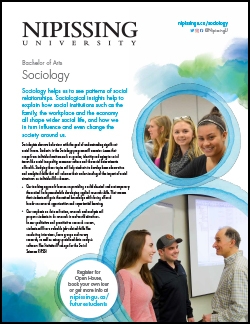
Welcome to Sociology at Nipissing
We offer the following Sociology degree options:
Have you ever stopped to think about the society in which you live—how it’s organized, how its institutions began, and how being part of a society affects your life? And what about all the different societies around the world?
If you choose to study Sociology—the study of human societies—you’ll be entering into a fascinatingly broad discipline. You’ll explore the sociological influences of many topics like the family, workplace, education, medicine, demographics, and the criminal justice system. For a taste of that diversity, consider this: some of our professors study areas ranging from mental health issues in older offenders in the criminal justice system, to contraception and family planning in Iran, to palliative care!
Sociology at Nipissing University
Sociology at Nipissing University offers a range of methodological and theoretical approaches, but our areas of specialization focus on the following key areas:
- Health, Demography and Aging: fertility and family planning; social gerontology; illness & mental disorder; palliative care; social determinants of health; retirement and pensions; age discrimination; human sexuality
- Social Stratification, Work and Labour Markets: social origins and educational outcomes; hiring and retirement discrimination; gender inequality; school-to-work transitions; postsecondary access; employment outcomes; alternative forms of education
- Science, Technology and Society: knowledge exchange, mobilization and commercialization; water reuse technologies; sociology of the environment; sociology of risk; indigenous knowledges; mass media and culture
- Globalization, Development and Organizations: aboriginal communities and resource development; the global south; institutional analysis; sociology of organizations; sustainability and political processes
These substantive areas of interest are combined with expertise in contemporary and classical theories, program and policy evaluation, survey methods, quantitative research methods and statistics, and qualitative methods.
Nipissing University Research Data Centre (RDC)
The Statistics Canada Research Data Centre at Nipissing University, provides access to detailed data for research, promotes the use of data through associated training, and assists in the dissemination of research results.
Professional, Non-profit Associations:
- Canadian Sociological Association
- American Sociological Association
- International Sociological Association
- European Sociological Association
- Asia Pacific Sociological Association
Resources:
- SocioSite
- ASA (American Sociological Association) Style Guide
- WWW Virtual Library: Sociology
- The SocioWeb: A Guide to Sociology and Sociological Research
- Statistics Canada
- Sociology Central
- Advice on Academic Writing (University of Toronto)
- Writing Sociology Papers (University of North Carolina, Chapel Hill)
- Undergraduate Writing Resources in Sociology (University of California, Berkeley)
- Social Science Space
Thesis and Independent Study Applications
Academic Support Services
Our goal is to support your academic and personal development. Look for assistance with accessibility services, learning style assessments, writing skills, writing formats, study strategies, time management, note-taking skills, academic resources, group seminars, peer support, career development activities, and more. Learn More...
Financial Support Services
Achieve your goals on time and on budget. We’ll help you fund your education through scholarships, awards, bursaries, government assistance, and work study programs. Learn More...
Scholarships, awards, and bursaries for students in the Sociology program
Internationalize your Degree
If you want to experience a year or a semester at one of our partner schools across the globe, we have support services and programs to help you get there. If you want to assist International students with adjusting to life in Canada, we’ll connect you. Check out your options...
Personal Counselling Services
Our registered counsellors offer free, year-round personal counselling services, specialized therapeutic groups, referral services and a host of wellness, educational and awareness events to all full- and part-time undergraduate and graduate students. Learn More...
Residences
Our top-rated residences will make you feel right at home. You will make fast friends with your residence community. Our student leaders, Residence Dons, and award winning residence staff give tutorials on everything from the basics of laundry and cooking to making connections within the community. Learn More...
The Sociology-Anthropology Student Society
There are tons of ways to get involved in campus life, but one way is through the Sociology Club, which organizes events and guest speakers throughout the year.
Inaugural public lecture
In the summer of 2016, Nipissing University students Isaac Bender and Gab Lavoie had the opportunity to travel to the Republic of Ireland to participate in the excavation of a 13th century Dominican Friary, uncovering a variety of material artifacts and human burials. Their talk, titled "An Mainistir Dubh: a lecture on Irish archaeology at the Blackfriary," will share their experiences in excavating the medieval site, and outline how their findings help the community of Trim understand the context of the Friary within the city. Light refreshments will be served.
“I hear and I forget, I see and I remember, I do and I understand.” Confucius
Experiential learning is an effective medium that enhances and reinforces classroom learning. In addition, skills and competencies in the areas of communication, teamwork, analysis, work ethic, and problem solving are all learning outcomes that assist with finding the right career path for you.
Third and fourth year Arts and Science Students will be interested in our 3 credit course, UNIV 3006 Experiential Learning for Arts and Science Students. Within this course, academic assignments and at least 60 hours of placement in the community within a field that is related to your course of study is offered.
Leadership and Community Engagement
If you are eager to get involved beyond the classroom, take part in the annual Undergraduate Research Conference, which gives you the opportunity to present your work to peers, professors, and family members. You may also have opportunity to work as a Research Assistant to help a professor conduct research and gain valuable experience at the same time.
Record of Student Development
Your experience at Nipissing University is more than just the time spent learning great things in lectures, labs, and seminars. It’s also about the activities you are involved in outside of the classroom, the causes you champion to make change on campus, the clubs you organize, the awards you receive, the workshops you participate in, the volunteering you do, and all the learning that occurs outside of the classroom.
The Record of Student Development (RSD) is Nipissing University's way of recognizing that learning is happening everywhere on campus. It is a formal record, otherwise known as a co-curricular transcript, where you can include workshops, volunteer experiences, awards, activities, and on campus employment experiences that you participate in throughout your degree.
Each RSD Approved activity in our database is linked to competency areas employers are looking for such as:
- Critical Thinking
- Leadership
- Digital Literacy
- Equity and Diversity
- Emotional and Interpersonal Intelligence
- & more!
To see the full list of competencies and get started building your Record of Student Development go to: rsd.nipissingu.ca
Nipissing University Student Union (NUSU)
Students attending Nipissing University in North Bay and long distance students are members of the Nipissing University Student Union. Our organization strives to represent students democratically, provide a communication framework, and lobby for legislative change on issues that affect students.
Athletics
Exercise and healthy competition always help to clear the mind.
INTRAMURAL SPORTS
Nipissing’s Athletics Department offers a wide range of intramural activities to keep you on your game
LAKERS CLUB SPORTS
Club sports are available to all Nipissing students and are both recreational and competitive.
VARSITY SPORTS
Go Lakers! Our varsity athletes always bring their “A” game. Get your friends together and come out to cheer on your favourite teams.
STUDENT ATHLETICS CENTRE
Whether you are a gym enthusiast or a weekend warrior, Nipissing has just what you need.
Chair
 Extension4208Website
Program Representative
 Extension4232Website—
Full-time Faculty
 Extension4181EmailWebsite—
 Extension4310EmailWebsite
 Extension4019EmailWebsite
 Extension4164Website—
 Extension4889EmailWebsite—
 Extension4427EmailWebsite—
 Extension4317Website
 Extension4154EmailWebsite—
 Extension4026Website—
 Extension4386EmailWebsite
Adjunct Professor
 Extension—EmailWebsite—
 Extension—Website—
Megan Odd, BA (Hon.) '20, MA Sociology: Applied Social Research '22“I will be forever grateful for my experience at Nipissing. The ability to complete both my undergraduate and graduate degree at the same university has led to many advantages. During my undergraduate degree, one of my professors — Dr. Amir Erfani — took me “under his wing” and helped guide me in the right direction to achieve both my academic and professional goals. This mentorship led to completing an undergraduate thesis in partnership with the Ontario Provincial Police, on the implementation of the amber-red advanced warning light system on school buses in Ontario. As a result, I had the opportunity to present my research to Ontario’s Legislative Assembly. During my graduate degree, I once again had the opportunity to work under the supervision of Dr. Erfani on my Master’s thesis research project. The smaller class sizes at Nipissing allow for students to build these relationships with their professors, that would likely not occur at other universities.
Nipissing offers undergraduate level advanced statistical methods, and survey research courses. These courses adequately prepare students and ensure they have a well rounded understanding of various research and statistical analysis methodologies. This is extremely beneficial when taking the graduate level courses. I have noticed that some of my fellow classmates who did not take the research courses during undergrad, were less prepared and further had a more difficult time comprehending the material being delivered to us. I highly recommend the Sociology: Applied Social Research program to anyone who is considering a career in a research-based field.”
Housing and Homelessness Planner and Analyst, DNSSAB
Brittany Etmanski, - BA (Hon.) ‘13, MA ‘15, PhD candidate"Nipissing University's Sociology program distinguishes itself through its small class sizes and the approachable nature of many of the professors within the department. The research I conducted with my previous advisor (Dr. David Zarifa) provided the foundation for my current studies at the graduate level. Further, this experience fostered a long-lasting connection, as he continues to act as one of my mentors."
Cassandra Hill - BA (Hon.) ‘11, MA ‘16"My experience at Nipissing University is one I am forever grateful for. Aside from meeting amazing people, I was able form special relationships with the faculty. The small class sizes allowed for a better learning environment. I went to a much larger university prior to attending Nipissing and the amount of knowledge gained in the courses and hands on experience, and the amount of care the faculty has towards their students is unbelievable at Nipissing. I was learning how to properly read theoretical and epistemological literature in my second year and sophisticated survey methodology and quantitative analyses in my fourth year: something that my fellow peers at graduate school were learning for the first time. I am still able to maintain these relationships with these Professors today and it is amazing to see how much they care about where you are now. My educational experience at Nipissing within the Sociology department is one that I hope other students will some day experience. I believe I would not be where I am today as a Research Assistant for the Women's College Hospital for violence against women if it wasn't for the care and passion for teaching within this institution."
Research Assistant for the Women's College Hospital
Victoria Spofford, - BA (Hon.) '11, MA '16, PhD candidate"I had a fantastic experience at Nipissing University. The small class sizes ensure that every student has the opportunity to get to know their fellow classmates, and everyone gets a lot of hands-on attention from the professors. I had the opportunity to work as a research assistant and a teaching assistant alongside my thesis supervisor, Dr. Amir Erfani--experience that it unheard of at the undergraduate level in other universities, which I feel was a great advantage to me in grad school. I was also fortunate enough to learn advanced statistical methods during my undergrad, which have greatly helped me both academically and professionally."
Research/Data Manager at Health Canada
Katie Bedard - BA ‘11"The availability and helpfulness of professors provided for an excellent experience during my time as a student at Nipissing University. When I had academic challenges, my professors were always available to assist, but beyond that, I received their constant encouragement. My sociology professor Dr. Amir Erfani, for instance, encouraged me to enroll in an upper year statistics course, something I did not think I could do. He assured me that he knew that I was capable, and he was right. I excelled in the course and he then supported me in completing my thesis, which I had up until that point no plans of pursuing. After graduating, he and other professors went out of their way to assist with recommendations for scholarships and graduate school applications and I appreciated that each was able to speak to me as a student, and not just a grade point average."
Client Service Administrator at ListenUP! Canada
A degree in Sociology will give you many skills that you can use in different careers. You might launch a career in areas as diverse as social services, corrections, demographic research, or social psychology, to name just a few.
You might also continue on into a Master’s degree or Doctorate in graduate school, or a professional program like teaching or law. One of our former students is now a Supreme Court Justice!
Master of Arts in Sociology
Career and Academic Options
- Graduate Studies
- Professional School (Education, Law, MBA, MPA)
- Careers in government, labour relations, human resources, healthcare, social services, corrections, policing, community development, minister/clergy, consulting and research