
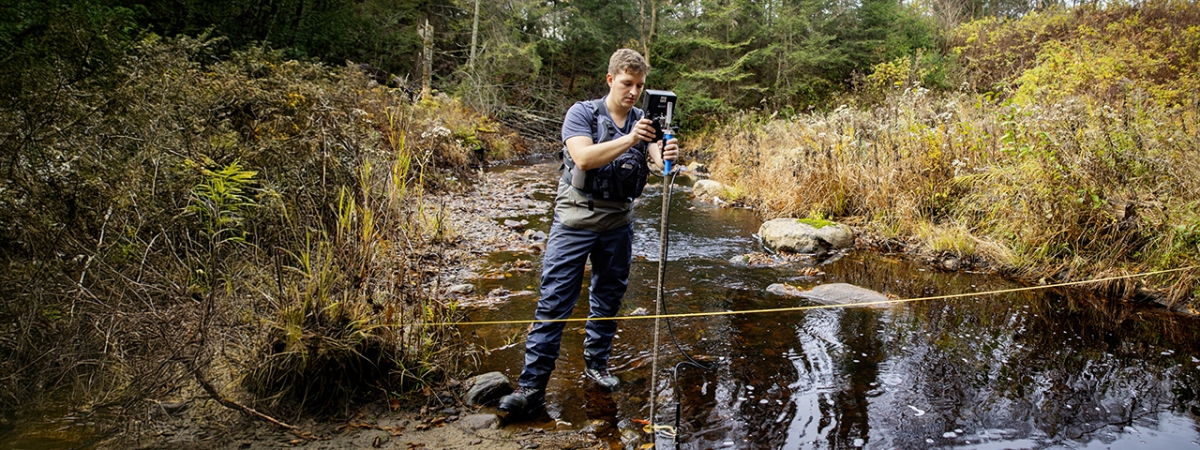
Confront Big Questions in Our Changing Environment
Environmental challenges like climate change, biodiversity loss, and resource management are among the most urgent issues of our time. Nipissing University’s Environmental Science program offers an interdisciplinary, science-focused approach training across biology, chemistry, geography, and environmental research. This program prepares students to address complex environmental problems in ways that engage governments, industry, and Indigenous communities.
Why Choose Environmental Science at Nipissing?
- Interdisciplinary Focus: Learn to approach environmental issues from multiple scientific perspectives.
- Cutting-Edge Expertise: Study with faculty recognized nationally and internationally, including Canada Research Chairs in environmental research.
- Real-World Learning: Participate in fieldwork, lab-based research, and community-engaged projects.
- Small Classes, Big Impact: Experience mentorship and collaboration in a supportive learning environment.
- Pathway to Graduate Studies: Build a foundation for Nipissing’s MES/MESc program and other advanced studies.
Bachelor of Science (BSc) in Environmental Science
4 years | Undergraduate Program | In-person
Get Started Today!
Join Nipissing University’s Environmental Science program and prepare to shape solutions for the world’s most pressing environmental challenges.
Program Highlights
- Climate and Environmental Change: Explore the science behind shifting ecosystems and weather patterns.
- Environmental Chemistry: Gain specialized knowledge through a certificate option that focuses on chemical processes shaping the environment.
- Ecology and Resource Management: Study the dynamics of living populations, ecosystems, and sustainable practices.
- Human–Environment Interaction: Understand the connections between natural and human landscapes, with a focus on northern and Indigenous contexts.
Our goal is to support your academic and personal development. Look for assistance with accessibility services, learning style assessments, writing skills, writing formats, study strategies, time management, note-taking skills, academic resources, group seminars, peer support, career development activities, and more. Learn More... Achieve your goals on time and on budget. We’ll help you fund your education through scholarships, awards, bursaries, government assistance, and work study programs. Learn More...Academic Support Services
Financial Support Services
Scholarships, awards, and bursaries for students in Biology programs
If you want to experience a year or a semester at one of our partner schools across the globe, we have support services and programs to help you get there. If you want to assist International students with adjusting to life in Canada, we’ll connect you. Check out your options... Our registered counsellors offer free, year-round personal counselling services, specialized therapeutic groups, referral services and a host of wellness, educational and awareness events to all full- and part-time undergraduate and graduate students. Learn More... Our top-rated residences will make you feel right at home. You will make fast friends with your residence community. Our student leaders, Residence Dons, and award winning residence staff give tutorials on everything from the basics of laundry and cooking to making connections within the community. Learn More...Internationalize your Degree
Personal Counselling Services
Residences
Experiential learning is an effective medium that enhances and reinforces classroom learning. In addition, skills and competencies in the areas of communication, teamwork, analysis, work ethic, and problem solving are all learning outcomes that assist with finding the right career path for you. Third and fourth year Arts and Science Students will be interested in our 3 credit course, UNIV 3006 Experiential Learning for Arts and Science Students. Within this course, academic assignments and at least 60 hours of placement in the community within a field that is related to your course of study is offered.“I hear and I forget, I see and I remember, I do and I understand.” Confucius
If you are eager to get involved beyond the classroom, take part in the annual Undergraduate Research Conference, which gives you the opportunity to present your work to peers, professors, and family members. You may also have opportunity to work as a Research Assistant to help a professor conduct research and gain valuable experience at the same time. Your experience at Nipissing University is more than just the time spent learning great things in lectures, labs, and seminars. It’s also about the activities you are involved in outside of the classroom, the causes you champion to make change on campus, the clubs you organize, the awards you receive, the workshops you participate in, the volunteering you do, and all the learning that occurs outside of the classroom. The Record of Student Development (RSD) is Nipissing University's way of recognizing that learning is happening everywhere on campus. It is a formal record, otherwise known as a co-curricular transcript, where you can include workshops, volunteer experiences, awards, activities, and on campus employment experiences that you participate in throughout your degree. Each RSD Approved activity in our database is linked to competency areas employers are looking for such as: To see the full list of competencies and get started building your Record of Student Development go to: rsd.nipissingu.ca Students attending Nipissing University in North Bay and long distance students are members of the Nipissing University Student Union. Our organization strives to represent students democratically, provide a communication framework, and lobby for legislative change on issues that affect students. Exercise and healthy competition always help to clear the mind. Nipissing’s Athletics Department offers a wide range of intramural activities to keep you on your game Club sports are available to all Nipissing students and are both recreational and competitive. Go Lakers! Our varsity athletes always bring their “A” game. Get your friends together and come out to cheer on your favourite teams. Whether you are a gym enthusiast or a weekend warrior, Nipissing has just what you need.Leadership and Community Engagement
Record of Student Development
Nipissing University Student Union (NUSU)
Athletics
INTRAMURAL SPORTS
LAKERS CLUB SPORTS
VARSITY SPORTS
STUDENT ATHLETICS CENTRE
Chair
 Extension4062EmailWebsite
Full-time Faculty
 Extension4462Website—
 Extension4701Website
 Extension4814Website
 Extension4430Website
 Extension4336EmailWebsite
 Extension4297Website—
 Extension4323EmailWebsite—
 Extension4425EmailWebsite—
 Extension4155EmailWebsite—
Program Outcomes & Career Paths
Graduates of Environmental Science at Nipissing University develop the scientific knowledge, critical thinking, and applied research skills to address environmental challenges in diverse settings.
Where Can an Environmental Science Degree Take You?
- Further Studies: Graduate-level programs in environmental science, environmental studies, planning, or related STEM fields.
- Industry & Government: Roles in environmental monitoring, climate adaptation, and natural resource management.
- Community & Non-Profit: Work with conservation organizations, Indigenous governments, or sustainability initiatives.
Career Ideas for Environmental Science Graduates
- Environmental Scientist
- Climate Policy Analyst
- Conservation Biologist
- Environmental Chemist
- Water Resources Specialist
- Renewable Energy Consultant
- Land and Resource Manager
- GIS and Environmental Data Analyst
- Environmental Educator
- Researcher or Professor