
Environmental Geography graduate Nathan Mountain presented his research poster entitled “Volume Dependent Fissioning in Planaria” four years ago. The experience gave him the confidence he needed to take his poster to a larger conference in Washington, DC.
He also had a great item to add to his CV.
“Participating in the event three years ago helped me get into graduate school,” says Mountain, who has graduated from the Master of Environmental Science/Studies Program at Nipissing University. Nathan completed his Masters thesis under Dr. April James, Canada Research Chair in Watershed Modeling and Analysis. “I got a taste of academic research – and I really enjoyed it. I knew I wanted to continue with it.”
Nathan’s suggestion for a great poster: “Make it concise but self-explanatory. Judges will want to have all the key information. Their discussion with you will be for the extras.”
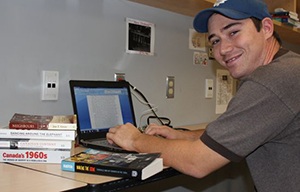
When Grant Doherty presented his paper “National Energy Program: Reactions through the American Media” at NU’s Undergraduate Research Conference, he figured he’d chat with a few other history students about Pierre Trudeau.
He didn’t expect to be engaged by geography and business students about Canada’s current and future energy policy.
“It was a great experience. You’re often so busy doing your own thing, that you forget there are other students and departments doing research that can connect with your own,” says Doherty.
“At the UGRC, the professors were very constructive. Often at conferences, questions can be very critical of your work. The focus of this conference is to provide a learning experience.”
He made a 15-minute presentation of his paper, on a panel about environmental policy. The interdisciplinary-nature of the conference means panel presenters may come from different areas of expertise. As a result, they become collaborative and often thought-provoking. Presenting his paper, gave him a taste of life as an academic scholar. Grant then went on to complete his Masters Degree at Nipissing University.
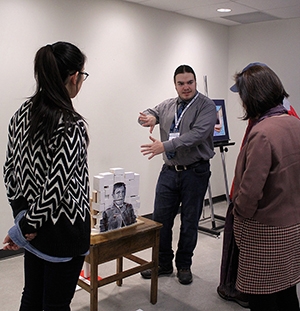
When Gerald McComb exhibited his mixed media sculpture, The Civilized, at the UGRC he found that there were many viewers interested in the subject matter and themes addressed by his work. He said, “The conference was an excellent opportunity to have my work exhibited and to be present to explain the meaning of my work and answer questions.” Gerald’s art practice has always focused on Indigenous issues and the process of healing from the lasting effects of colonialism and oppression. His work speaks to his own experience, and in telling his story he aims to bring understanding to those who are unaware of what First Nations people are going through.
After graduating with his Bachelor of Fine Arts (BFA), Gerald continued to expand his creative practice by curating the exhibition Teamwork Makes the Dream Work at the W.K.P. Kennedy Gallery in North Bay. He is currently the Artist in Residence for the University of Hearst where he is working on a project that discusses reconciliation and bringing communities together through the arts.

Imogen Wilson’s presentation titled, “The Jewish Museum: Challenging Perceptions of History and Spectatorship,” earned her a UGRC award for best paper. She presented her analysis on the architectural and visual choices made within the Jewish Museum—a museum she had personally visited when in Berlin. The core of Wilson’s research centred around the question, “do these experimental spaces help us to understand the past or do they separate us from it?”
The UGRC paper presentation gave Imogen a chance to share the research she had been doing in her Art History & Visual Studies course. Her paper was included in the UGRC panel titled Reflecting and Representing Community.
Imogen graduated with her Bachelor of Fine Arts (BFA) and is currently pursuing a Master of Fine Arts at the University of Windsor, School for the Creative Arts. She is also employed as a graduate assistant.